
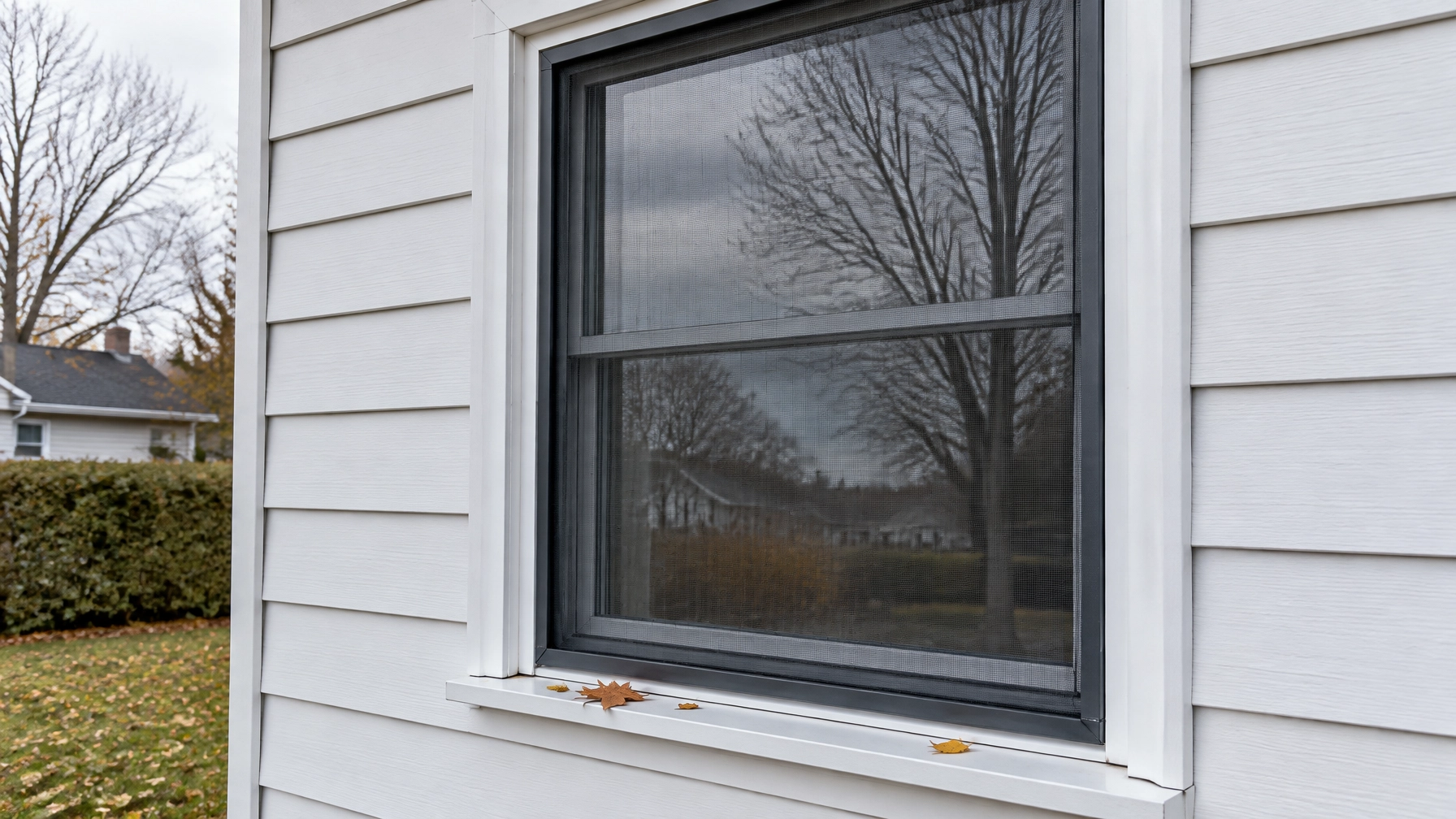
The screens did their job in July. By mid-November they are still up, holding a summer of dust, pollen and street grit against glass you can no longer open anyway.
Leaving them there is not a disaster. Taking them down, washing them and storing them flat is a small job that pays off twice: the glass stays clearer through the winter, and the screens come back in spring without a bent frame or a torn corner.
Here is the short version. On a mild day above freezing, take off the screens that come out easily from inside, wash them with mild soap and a soft brush, let them dry completely, and store them flat in a dry spot. If a screen will not come out from inside, leave it alone. And do not count on a screen to stop anyone from falling out of a window, because it will not.
Why take them down at all
Three reasons, in order of how much they matter.
The first is condensation. A screen sits a couple of centimetres in front of the glass and slows warm room air from reaching the pane. Take it off and the inside glass stays a little warmer, which means less water running down to the sill on cold mornings. CAA-Quebec's fall maintenance guide lists screen removal under doors and windows for exactly that reason.
The second is wear. A screen left up through a Quebec winter collects snow and ice in the mesh. That weight and the freeze-thaw cycle are hard on aluminum frames and on the spline that holds the mesh in its groove. Screens stored indoors come back straighter.
The third is light. A screen that has held a summer of dust cuts the light coming in, and on a grey November afternoon you notice it more than you would think.
Which screens come off, and which stay
Most screens on West Island and Montreal houses either clip into the window frame, slide up into a channel, or swing out on small tabs. From inside, look for two spring tabs at the bottom or the sides. Push them in or up, tilt the frame toward you, and lift it out.
Some screens are mounted on the outside of the sash, some sit behind a storm panel, and some older windows have screens that were never meant to come out by hand. Height and location decide the rest. A second-floor screen over a sloping driveway is not the same job as a ground-floor kitchen window, and reaching out over a sill to unhook a screen is how people fall.
If a screen will not release from inside with an easy push, leave it and make a note. Stanley can look at it during a visit and tell you whether it comes out and what that takes.
Wash them before they go into storage
Dust first, water second. Two passes.
Start dry: brush both sides of the mesh with a soft brush, or use a vacuum with the brush attachment on low. Most of what a screen holds is loose.
Then wash: lukewarm water with a few drops of mild dish soap, a soft brush or sponge, working gently in both directions. Rinse with a garden hose on low pressure, or in a shower for a small screen. Skip the pressure washer, and skip anything with bleach or strong ammonia, because both can attack the mesh, the frame finish and the spline. A stiff brush pulls threads.
Stand the screen up or hang it to dry completely before it goes anywhere near storage. A screen put away damp comes out in spring with a smell, and sometimes with corrosion along the frame.
If the mesh is already torn or the frame is bent, a wash will not fix it. That is a repair or replacement decision, best made in spring when you can see what you have.
Where to store them until spring
Flat is best, or standing on edge against a wall. Not stacked under boxes, and not leaning at an angle where the frame carries the weight.
A dry basement wall, a garage shelf or the back of a closet all work. Avoid a damp crawlspace, a shed with a leak, or anywhere the screen sits against bare concrete. Label each one with a piece of tape on the frame: kitchen, upstairs hall, back bedroom. In spring you will not remember, and a screen that goes back on the wrong window usually gets forced.
The part that matters more than the screen
A window screen keeps insects out. It does not keep a child in.
Screens are held by a thin spline in a light aluminum frame, and most of them push out under body weight. Ottawa Public Health is direct about it: window screens do not prevent children from falling out of a window. What does is a window guard or a limiter that stops the window from opening more than 10 cm, plus keeping furniture away from the window so a child cannot climb to the sill.
That holds in November as much as in July. A window opened wide on a mild afternoon in a house with a toddler is the same risk whether or not the screen is still in place.
What a cleaning visit covers, and what it does not
Screens can be washed during a window cleaning visit when they are part of the agreed scope, along with the glass, frames and sills. Not every screen in a house can be reached safely, and some are fixed in ways that make removal a different job. Stanley confirms which windows and which surfaces are included after seeing the house, rather than promising a number over the phone.
Interior glass and screens can be scheduled later into the season. Exterior work depends on the weather and the temperature, and no one should promise you a clean exterior elevation in freezing conditions.
If the glass still fogs on the inside after the screens are off, the screen was not the cause. That is a humidity question, and our guide to condensation on your windows covers what to check first. If you are still working through the outdoor list, the winter window and gutter prep guide handles the rest.
A short checklist before the first big snow
- Pick a mild day above freezing and start with the screens you can reach from inside.
- Brush both sides dry, then wash with mild soap and a soft brush.
- Rinse on low pressure and let the screen dry completely.
- Tape a room label on the frame and store it flat in a dry spot.
- Note any torn mesh, bent frame or screen that would not come out.
- If there are young children, check the window guards and clear the furniture away from the windows.
If the screens and the glass could both use a pass before winter, request a quote from Flip et Bulles. Tell us how many windows are involved and which floors they are on, and Stanley will confirm what is included before anything is booked.